The performance marketing world is having an identity crisis right now, and it is a productive one. AI tools are generating creatives, launching campaigns, reallocating budgets, and surfacing winners at a speed that would have seemed implausible just a few years ago. At the same time, experienced media buyers are still in demand, still commanding strong rates, and still doing work that matters.
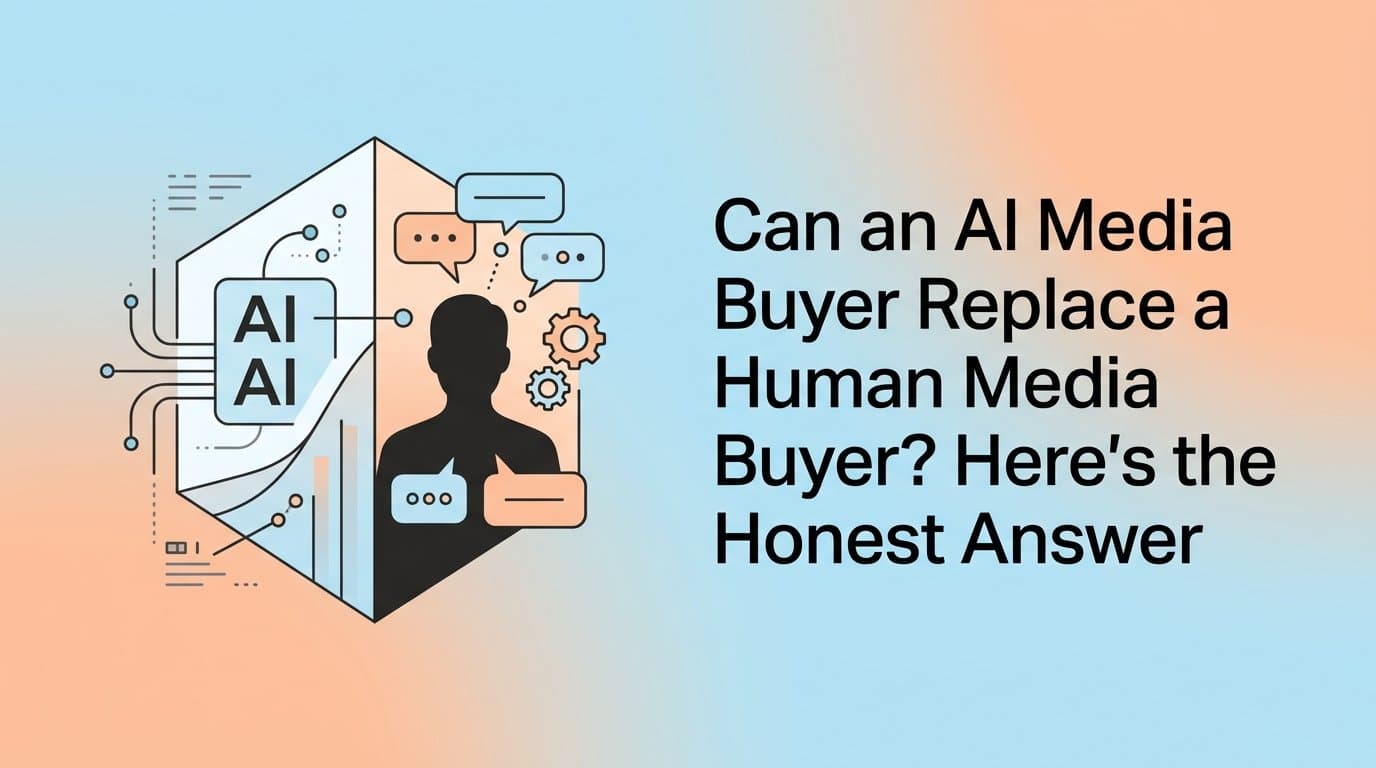
So the question sitting at the center of this tension is a fair one: can an AI media buyer replace a human media buyer? It is not a question born of hype or fear alone. It is a legitimate strategic question that business owners, marketing directors, and media buyers themselves are wrestling with right now.
The honest answer is not a clean yes or no. It depends on what part of the job you are talking about, what kind of business is asking, and what you actually mean by the word "replace." That last part matters more than most people realize. Replace implies a one-to-one swap, a human out, a machine in, same inputs and outputs. But that framing misses what is actually happening in practice.
What is actually happening is more interesting and, depending on your perspective, more hopeful than the replacement narrative suggests. AI is absorbing a specific layer of media buying work, the execution layer, with impressive competence. The layer underneath it, the one involving judgment, brand stewardship, and human communication, remains stubbornly human for now.
This article is an honest breakdown of where that line sits today. Not a sales pitch, not a dismissal of either side, and not a prediction about 2030. Just a clear-eyed look at what AI does well, what it still cannot do, and what the smartest response looks like for anyone on either side of this question.
The Real Daily Reality of a Media Buyer's Job
Ask most people outside of performance marketing what a media buyer does and you will get a vague answer about "running ads." Ask someone who has actually done the job and they will describe something that looks a lot more like operational management than creative strategy.
A typical media buyer's day involves pulling performance data from multiple ad accounts, identifying which campaigns are over- or under-pacing against budget, adjusting bids and budget allocations based on what the numbers are showing, and then writing up a brief for a designer because two of the current creatives are fatiguing. Then there is a client call to explain why ROAS dipped last week, a round of copy revisions for a new product launch, and an audience analysis to figure out whether the 35-44 segment is still performing or whether it is time to test a new cohort.
That is the execution layer. It is real work, it requires skill, and it takes up the majority of a media buyer's week. But it is also largely rules-based and data-driven. The decisions being made are important, but they follow a logic that can be systematized: if performance drops below this threshold, pause and reallocate; if creative frequency exceeds this number, rotate in new assets; if a new audience segment outperforms the control, scale it.
Underneath the execution layer is something different: judgment. This is the part of the job that involves deciding whether a campaign concept actually fits the brand's positioning, reading a cultural moment correctly before committing to a creative direction, knowing when to deliberately sacrifice short-term ROAS for long-term brand equity, and managing the human dynamics of a client relationship when expectations and reality are not aligned.
These two layers, execution and judgment, respond very differently to automation. And understanding the distinction between them is the key to answering the replacement question honestly.
The important thing to acknowledge is that for most media buyers, a significant portion of the week is reactive busywork rather than proactive strategy. Pulling reports, reformatting data, briefing designers on minor creative tweaks, answering status questions that could be answered by a dashboard. This is not a criticism of media buyers. It is a structural reality of the job as it has existed. And it is precisely the gap that AI was built to fill.
Where AI Already Has the Edge
There are specific areas where AI media buying capabilities are not just comparable to human performance, they are genuinely superior. Being honest about this is not a threat to human media buyers. It is the starting point for understanding where their real value lives.
Speed and scale without degradation: A human media buyer can manage a finite number of campaigns before attention degrades and mistakes increase. An AI agent can monitor and adjust hundreds of campaigns simultaneously, analyze thousands of creative and audience combinations, and react to performance signals in real time rather than waiting for a scheduled review. The math here is simply not competitive. Scale is an AI advantage by design.
Pattern recognition across large datasets: One of the persistent challenges in performance marketing is that humans bring cognitive bias to their own campaigns. We remember the creative we were excited about and unconsciously weight the data in its favor. We anchor to the audience that worked last quarter even when the numbers suggest it is fading. AI does not have these tendencies. It reads the data as it is and surfaces patterns that a human reviewer might miss, particularly when those patterns emerge across large volumes of variables simultaneously.
This is where features like AI Insights and Winners Hub in platforms like AdStellar become genuinely powerful. When every creative, headline, audience, and landing page is ranked by actual metrics like ROAS, CPA, and CTR, and scored against your specific goals, the signal-to-noise ratio improves dramatically. You are not guessing which ad is working. You are looking at a leaderboard built on real performance data.
Continuous optimization without context-switching cost: A human media buyer juggles accounts, meetings, briefs, and internal communications throughout the day. Every context switch has a cost. Every meeting is time not spent on optimization. An AI agent has no such constraints. It monitors campaigns continuously, pauses underperformers the moment data justifies it, and scales winners without waiting for a human to find a gap in their calendar.
Creative generation at volume: Briefing a designer, waiting for assets, reviewing rounds of feedback, and managing revisions is a slow cycle that limits how many creative variations a team can test. AI changes this equation entirely. The ability to generate image ads, video ads, and UGC-style creatives from a product URL, and then launch hundreds of variations through bulk ad launch tools, compresses a process that used to take weeks into something that happens in hours.
These are not marginal improvements. They represent a structural shift in what is possible for a small team or even a solo operator running Meta campaigns.
What AI Still Cannot Do on Its Own
Here is where the honest answer requires some precision, because the limitations of current AI in media buying are real and they matter strategically.
Strategic brand judgment: AI can optimize toward a metric. It cannot decide whether optimizing toward that metric is the right thing to do for the brand. This distinction sounds abstract until you encounter it in practice. A campaign might generate strong click-through rates with creative that feels slightly off-brand, aggressive in tone, or misaligned with a product positioning decision made six months ago. The AI sees the CTR. It does not see the brand equity erosion happening underneath it.
Knowing when to deliberately break a performance pattern, to run a brand-building campaign that sacrifices short-term ROAS for long-term recognition, is a judgment call that requires understanding the business at a level AI does not currently access. That understanding lives in human context.
Relationship and communication layers: A meaningful portion of senior media buying work is not about ad accounts at all. It is about people. Translating vague business goals into a campaign brief that a team can execute. Managing a client who wants to cut budget right when the data suggests scaling. Pushing back on creative direction that will not work, diplomatically and with evidence. Building the kind of trust with stakeholders that makes bold recommendations possible.
None of this is something an AI agent does. It is human communication work, and it is often the layer that separates a media buyer who gets results from one who gets results and keeps clients.
Novel creative concepting: This is a nuanced one. AI can generate creative variations at impressive scale, and those variations can be genuinely effective. But the original insight, the understanding of what will resonate with a specific audience at a specific cultural moment, still benefits from human intuition and lived experience.
The difference between generating a hundred variations on a concept and having the concept in the first place is significant. AI excels at the former. The latter still draws on something harder to systematize: cultural awareness, empathy, and the kind of creative instinct that comes from being a human navigating the same world as your audience.
Ambiguous goal translation: When a business owner says "we want to grow our brand," that is not a campaign objective. Turning that ambiguous goal into a concrete strategy, with the right objective, the right audience approach, and the right success metrics, requires a conversation and a level of interpretive judgment that AI is not yet equipped to handle reliably on its own.
The Real Shift: From Replacement to Multiplier
Here is the reframe that changes how this question feels: the more useful question is not "can an AI media buyer replace a human media buyer" but rather "what does a media buyer become when AI handles the execution layer?"
The answer is a strategist who operates at a much higher level with far fewer resources. Someone who is no longer spending the majority of their week on reactive operational tasks and can instead focus on the judgment work that actually drives long-term results. Brand positioning, creative strategy, audience insights, stakeholder relationships, and the kind of forward-looking thinking that execution-heavy weeks rarely leave room for.
This is the multiplier effect. AI does not shrink the role of a skilled media buyer. It expands what one person or a small team can accomplish. A solo marketer using an AI platform with creative generation, bulk ad launch, and automated performance surfacing can now operate at a volume and speed that would have required a much larger team just a few years ago. That is not a threat to the role. It is an upgrade to the role's leverage.
For small businesses and solo operators, the framing shifts even further. Many of these businesses never had a dedicated media buyer to begin with. They were running ads themselves, inconsistently and without the infrastructure to test and optimize properly. For them, an AI media buyer does not replace a human. It fills a role that was never filled. It brings professional-grade execution to a business that could not afford it otherwise.
This is arguably the more common and more transformative use case. Not a large team downsizing because of AI, but a small operation gaining capabilities that were previously out of reach. The competitive gap between a bootstrapped brand and a well-resourced agency is narrowing in a way that would not have been possible without these tools.
The businesses that recognize this shift early and learn to direct AI effectively are the ones that will compound the advantage. The ones that treat it as a threat to be resisted will find themselves outpaced by smaller, more agile competitors who figured out the multiplier model first.
A Practical Framework for Deciding What to Hand Off
Knowing that AI handles some things better than humans and humans handle other things better than AI is useful in theory. What is more useful is a practical framework for making the decision in your own workflow.
The core principle is straightforward: hand to AI anything that is data-driven, repetitive, and benefits from speed at scale. Keep with humans anything that requires brand judgment, stakeholder communication, or genuinely novel creative thinking.
In practice, the tasks to automate immediately include creative generation and A/B testing across multiple variables, budget reallocation based on ROAS and CPA thresholds, audience expansion testing to identify new segments worth scaling, performance reporting and leaderboard surfacing, and identifying creative fatigue signals before they erode campaign performance. These are all areas where AI operates faster, at greater volume, and without the cognitive overhead that slows human review cycles.
The tasks to keep with a human include setting campaign objectives when business goals are still being clarified, making brand positioning calls that affect creative direction, managing client or stakeholder relationships, deciding when to prioritize brand building over direct response, and generating the original creative concept before AI scales it into variations.
There are also warning signs worth watching for when AI is running without sufficient human oversight. Campaigns that optimize toward the wrong metric because the objective was set incorrectly from the start. Creatives that perform well in the data but feel off-brand or tonally wrong in context. Budgets that scale into audience segments that look good on paper but do not match the actual business goals. These are signals that the human judgment layer has been removed too completely, and that the oversight loop needs to be tightened.
The goal is not to automate everything. It is to automate the right things so that the human in the loop has more time and mental bandwidth for the decisions that actually require them.
The Bottom Line on AI and Human Media Buyers
The honest answer, after working through all of this, is layered but not complicated. AI media buyers can replace the execution layer of the job, and they can do it faster and at greater scale than any human team working with traditional tools. Creative generation, campaign launching, bulk testing, budget optimization, and performance surfacing are all areas where AI now performs at a level that makes the old manual approach look inefficient by comparison.
What AI cannot replace is strategic judgment, brand stewardship, stakeholder communication, and the kind of novel creative thinking that starts with a genuine human insight rather than a pattern in existing data. These capabilities remain human for now, and they are where experienced media buyers should be investing their development.
AdStellar is built around exactly this division of labor. The platform handles the execution layer: generating scroll-stopping image ads, video ads, and UGC-style creatives with AI, building and launching complete Meta campaigns through the AI Campaign Builder, running hundreds of ad variations through Bulk Ad Launch, and surfacing winners through AI Insights and the Winners Hub. Every combination is tested, every result is ranked, and the human in the loop gets to focus on strategy rather than spreadsheets.
The media buyers who thrive over the next few years will not be the ones who resist these tools. They will be the ones who learn to direct them effectively, using AI to handle the volume and speed that no human team can match, while applying their own judgment to the decisions that actually require it.
If you are ready to see what that looks like in practice, Start Free Trial With AdStellar and experience what it means to launch and scale campaigns with an AI platform that builds, tests, and surfaces winning ads based on real performance data.