UGC-style ads are consistently among the top performers on Meta. Performance marketers know this. Media buyers know this. The problem is not knowing that UGC works. The problem is getting enough of it, fast enough, without burning through your budget on creator fees, revision cycles, and production delays.
Traditional creator-sourced UGC is slow by nature. You find a creator, negotiate terms, send a brief, wait for a draft, request revisions, handle licensing, and repeat the whole process every time you want a new hook or persona. By the time you have three solid variations, your competitors have already tested a dozen.
So the question that keeps coming up in marketing circles is a fair one: can AI actually create realistic UGC content for ads? Not polished, obviously synthetic AI content, but the raw, conversational, person-forward style that blends into the Meta feed and earns genuine attention? And more importantly, does it perform well enough to matter?
The honest answer is more nuanced than a simple yes or no. AI-generated UGC has reached a point where it is genuinely useful for performance marketers, but it has specific strengths, specific limitations, and a specific strategic role. This article breaks all of that down, so you can make an informed decision about where AI UGC fits in your ad strategy.
Why UGC-Style Ads Earn Attention That Polished Creative Doesn't
Scroll through your Facebook or Instagram feed for sixty seconds and pay attention to what makes you stop. Chances are, it is not the perfectly lit studio product shot or the brand video with the cinematic soundtrack. It is the person looking directly into their phone camera, speaking in a casual tone, holding up a product they actually seem to use.
That pattern interrupt is not accidental. Native-looking content earns attention on Meta because it mimics the format of everything else in the feed. When an ad looks like a post from someone you follow, your brain does not immediately classify it as something to skip. That fraction of a second of engagement is where UGC-style ads earn their edge.
The visual and tonal signals that make something feel like authentic creator content are fairly consistent. Vertical video format. Direct-to-camera delivery. Casual, conversational language that sounds like someone talking to a friend rather than reading a script. Natural or everyday lighting rather than studio setups. Visible product use in relatable settings. An unscripted quality, even when the content is actually scripted. These signals together create a feeling of trust and proximity that polished brand creative rarely achieves.
The trust dimension matters especially on Meta, where audiences have become increasingly skeptical of obvious advertising. Content that feels like a genuine recommendation from a real person carries more weight than content that clearly originates from a brand's marketing department. This is the core reason UGC-style ads tend to outperform traditional creative across cold audiences, where there is no prior relationship with the brand to lean on.
Here is where the bottleneck becomes a real strategic problem. To test UGC at scale, you need volume. You need different hooks for the first three seconds, different personas, different scripts, different calls to action. Testing all of those variables with real creators means briefing multiple people, managing multiple timelines, handling multiple rounds of revisions, and paying talent fees for every variation. For most advertisers, that math does not work. The result is that most brands end up testing far fewer creative variations than they should, leaving performance gains on the table.
This is exactly the gap that AI-generated UGC is designed to fill.
The Technology Behind AI-Generated UGC Content
When people talk about AI UGC, they are usually referring to one of three distinct things, and the differences matter for how you use them.
AI-generated UGC refers to fully synthetic content where an AI avatar, a realistic-looking digital presenter, delivers a script in a format that resembles creator-shot video. These avatars are built using generative video models, text-to-speech synthesis, and compositing technology. You can typically customize the presenter's appearance, including skin tone, age, and speaking style, as well as the accent and pacing of the voice. The output is a video that, at typical social media viewing sizes and scroll speeds, is increasingly difficult to distinguish from content shot by a real person on their phone.
AI-assisted UGC is a different approach, where real human creators are involved but AI handles the scripting, editing, or post-production elements. This preserves the genuine human quality while accelerating the production process. It is a hybrid model that works well for brands that want authentic creator involvement but need to move faster or iterate more efficiently.
AI-styled image ads represent a third category: static or animated images designed to look organic and creator-sourced rather than brand-produced. Think product shots styled to look like someone's casual phone photo rather than a professional product photograph.
For the purposes of this article, the most relevant category for performance marketers is the first one: fully AI-generated avatar video that mimics the UGC format. Here is how that process typically works in practice.
A marketer provides a product URL or a brief describing the product and its key benefits. The AI generates a script in a conversational tone, selecting language that matches the casual, direct style of creator content. The platform then pairs that script with an avatar persona, renders the video with appropriate pacing and delivery, and produces a finished asset ready for ad use. The whole process can take minutes rather than days.
Modern tools have gotten remarkably good at replicating the visual signals that make content feel native. The framing, the lighting quality, the way the presenter looks directly into the camera, and the natural cadence of speech all contribute to a result that reads as UGC rather than brand creative to most viewers scrolling at normal speed.
AdStellar's AI Ad Creative feature works exactly this way. You can generate UGC-style avatar content directly from a product URL, with no designers, no video editors, and no actors involved. You can also clone competitor ads from the Meta Ad Library to understand what UGC formats are already working in your category before generating your own variations.
What AI UGC Gets Right and Where It Still Has Limits
Let's be direct about both sides of this equation, because the honest picture is more useful than an uncritical endorsement.
AI-generated UGC has genuine, practical advantages that are hard to overstate once you experience them in a real workflow.
Speed and volume: Generating ten UGC-style video variations with different hooks, different personas, and different scripts takes a fraction of the time it would take to source and brief even a single human creator. For creative testing, this is transformative.
No talent fees or scheduling conflicts: Every variation you produce costs the same, regardless of how many you need. There are no revision requests, no contract negotiations, and no waiting on someone else's availability.
Consistency and control: AI avatars deliver the script as written, every time. You control the messaging precisely, which matters when you are testing specific hooks or calls to action and need to isolate variables.
Multiple personas simultaneously: You can test the same script delivered by different avatar personas, different apparent ages, different demographics, to understand which presenter resonates with which audience segment. This kind of persona testing is impractical with real creators at any reasonable budget.
Now for the honest limitations, because they are real and worth understanding.
The uncanny valley effect is still a consideration, particularly in longer videos or close-up face shots where viewers have more time to notice that something feels slightly off. At typical social media viewing speeds and sizes, many viewers will not notice. But in longer-form content or highly scrutinized creative, the synthetic quality can become apparent.
Emotional nuance and genuine spontaneity are harder for AI to replicate. A real creator's unscripted laugh, their visible enthusiasm, or the way they naturally react to their own words carries a kind of authenticity that AI avatars have not fully captured yet. For products where community credibility matters, where a creator's existing relationship with their audience is part of the value, human creators still have a clear edge.
Some audiences are also becoming more attuned to synthetic content as AI-generated video becomes more common. This is worth monitoring as the technology continues to evolve.
The strategic sweet spot for AI UGC is top-of-funnel awareness and rapid creative testing with cold audiences. It is particularly effective for discovering which hooks, angles, and personas resonate before committing to more expensive production. For high-stakes brand moments, deeply community-driven products, or situations where a creator's personal endorsement carries significant weight, real creator involvement still adds value that AI cannot fully replicate.
One practical note: as of 2026, Meta has disclosure requirements for AI-generated content in certain ad categories. Marketers should stay current with Meta's advertising policies on synthetic media to ensure their campaigns remain compliant.
Scaling UGC-Style Creative Without a Production Team
The workflow shift that AI UGC enables is worth describing concretely, because it changes what is actually possible for a lean marketing team.
In a traditional UGC workflow, a single creative variation might take a week or more from brief to finished asset. If you want to test five different hooks, you are looking at weeks of lead time and significant cost before you have any performance data. Most advertisers end up running far fewer tests than the data suggests they should, simply because the production process makes volume impractical.
With AI-generated UGC, the timeline compresses dramatically. In a single working session, a marketer can generate multiple video variations with different opening hooks, different presenter personas, different scripts emphasizing different product benefits, and different calls to action. The creative testing matrix that used to require weeks of coordination can now be assembled in hours.
This matters because the first three seconds of a video ad are where most creative testing value lives. Different hooks perform very differently across audiences, and the only reliable way to find your best hook is to test several simultaneously. AI makes that kind of hook testing genuinely accessible, even for teams without a dedicated creative production function.
The next step is getting all of those variations into the market quickly, and this is where bulk launch capability becomes critical. Generating great creative is only valuable if you can deploy it efficiently. Having to manually set up each variation as a separate campaign in Ads Manager eliminates much of the time advantage you gained in production.
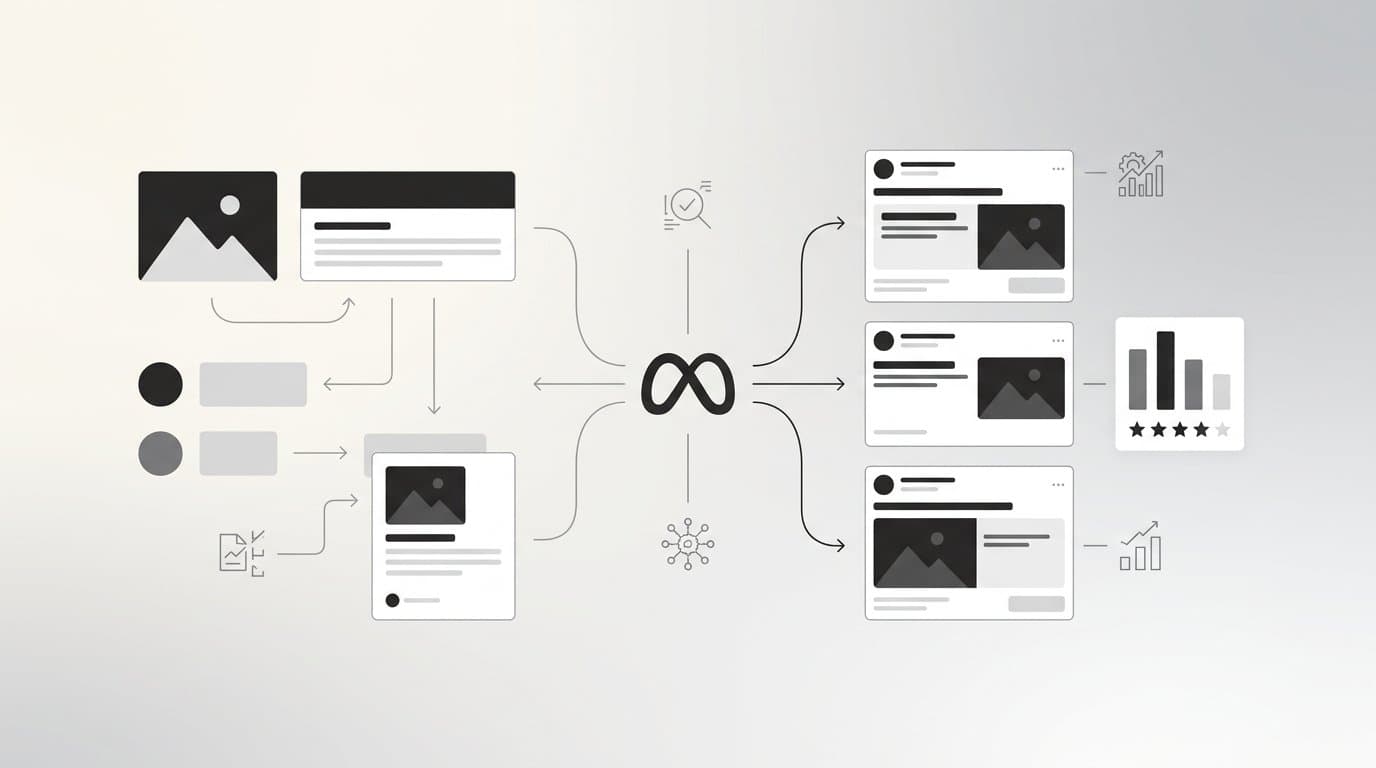
AdStellar's Bulk Ad Launch feature addresses this directly. After generating UGC-style avatar content with the AI Ad Creative tool, you can mix multiple creatives, headlines, audiences, and copy variations at both the ad set and ad level. AdStellar generates every combination and launches them all to Meta in clicks rather than hours. The entire workflow, from product URL to live Meta campaign, happens inside a single platform without switching between tools.
The AI Campaign Builder adds another layer by analyzing your past campaign performance, ranking every creative and audience by results, and building complete Meta Ad campaigns in minutes. Every decision is explained transparently, so you understand the strategy behind the structure rather than just accepting a black-box output. And because the system learns from your campaign history, it gets more effective over time.
For a media buyer or performance marketer who has been managing this process manually, the shift in how much creative volume becomes testable is significant. The constraint moves from production capacity to strategic thinking, which is where it should be.
Reading the Results: Turning Launch Data Into Winning Creative
Generating and launching UGC-style variations at scale is only half the equation. The other half is knowing which ones are actually working and why, so you can build on what is performing rather than starting from scratch every time.
This is where performance analysis becomes as important as creative generation. When you are running dozens of UGC variations simultaneously, the data can get complex quickly. Which avatar persona drove the lowest CPA? Which hook had the highest completion rate? Which script variation produced the best ROAS across a specific audience segment? Without organized, visual performance data, answering those questions requires significant manual analysis.
AdStellar's AI Insights feature handles this with leaderboards that rank your creatives, headlines, copy, audiences, and landing pages by the metrics that actually matter: ROAS, CPA, and CTR. You set your target goals, and the AI scores every element against your benchmarks. Instead of digging through Ads Manager to piece together performance comparisons, you get a clear view of what is working and what is not.
The practical value of this is not just efficiency. It is the ability to identify patterns across your UGC variations. If a particular avatar persona consistently outperforms others, that is a signal worth acting on. If a specific hook style drives stronger completion rates across multiple audiences, that insight should inform your next round of creative generation. The data from one testing cycle becomes the brief for the next one.
This is where the Winners Hub becomes particularly useful. Rather than letting top-performing creative get buried in campaign history, the Winners Hub stores your best-performing creatives, headlines, audiences, and more in one place, alongside their actual performance data. When you are ready to build the next campaign, you start from a position of proven results rather than guesswork. Select a winning UGC creative, add it to a new campaign, and build from there.
The compounding effect of this workflow is meaningful over time. Each testing cycle generates data. That data informs better creative decisions. Better creative decisions produce stronger performers. Those performers get stored and reused. The system improves with every campaign rather than resetting to zero each time.
Is AI UGC the Right Fit for Your Ad Strategy?
The decision framework here is actually fairly straightforward once you know what AI UGC is good at and where its limits are.
If you need to test creative at scale, reduce production costs, or move faster than a traditional creator workflow allows, AI UGC is a strong fit. It is particularly well-suited for cold traffic campaigns, top-of-funnel awareness, rapid hook testing, and any situation where creative volume is the constraint on your performance.
If your product relies heavily on community credibility, or if your audience is deeply familiar with specific creators in your space, human creator involvement still adds value that AI cannot fully replicate. The good news is that AI UGC and real creator content are not mutually exclusive. Many marketers use AI-generated variations for high-volume testing and reserve real creator partnerships for specific moments where the authentic relationship matters most.
The broader point is this: AI UGC is not about replacing authenticity. It is about removing the production bottleneck that prevents most advertisers from testing at the volume the data suggests they should. When the constraint on creative testing is budget and production time, most advertisers end up with less data and slower optimization cycles than they need. AI removes that constraint.
AdStellar is built to handle the entire workflow: AI UGC creation from a product URL, bulk launch across Meta, AI-powered performance insights, and a Winners Hub that stores your best performers for reuse. No designers, no video editors, no actors, and no switching between platforms.
Start Free Trial With AdStellar and generate your first AI UGC-style ad from a product URL. See what your creative testing workflow looks like when production time is no longer the bottleneck.