Launching hundreds of ad variations manually is a marketer's nightmare. You've got winning creatives, multiple audience segments to test, and dozens of campaign variations that need to go live—but Meta's Ads Manager forces you to build each one individually. What should take minutes stretches into hours of repetitive clicking, copying, and praying you didn't make a typo in campaign #43.
The math is brutal: Testing 5 creatives across 10 audiences with 3 different ad copy variations means 150 individual ads to build. At 3-4 minutes per ad setup, that's 7-10 hours of soul-crushing manual work. And that's just one campaign cycle.
Bulk ad launchers solve this scaling bottleneck by automating the repetitive parts of campaign creation. These tools let you upload creative assets, define your targeting parameters, set budget rules, and launch dozens or hundreds of ad variations simultaneously. The best platforms add AI-powered optimization that analyzes performance data and automatically generates new variations based on what's working.
This guide examines eight real bulk ad launching solutions, from enterprise-grade automation platforms to specialized Meta tools. You'll see what each tool does best, who should use it, and how pricing scales with your campaign volume.
1. AdStellar
Best for: AI-powered campaign generation based on historical performance data
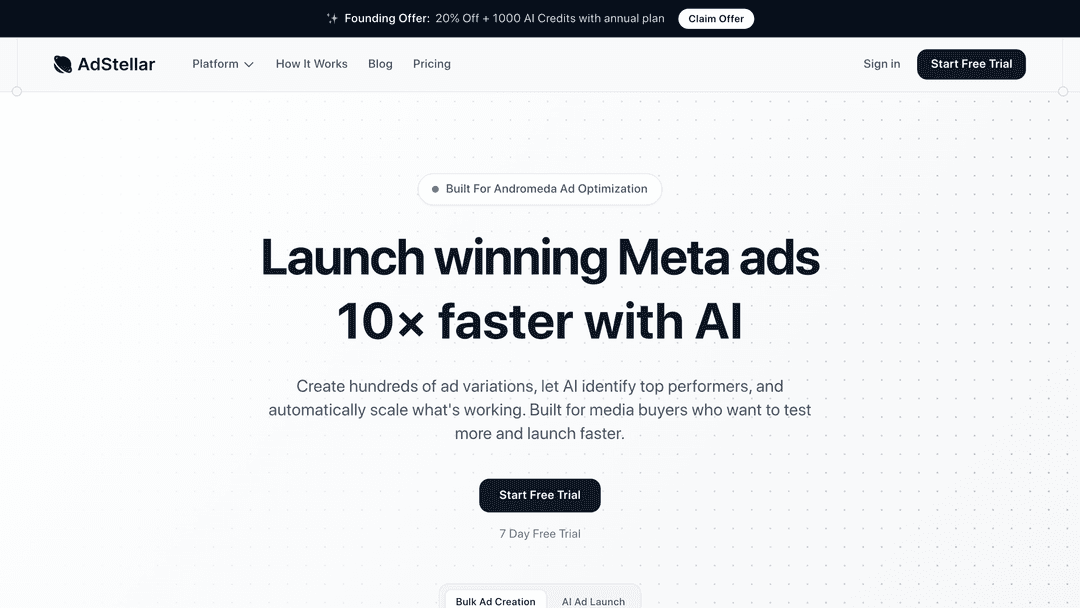
AdStellar is an AI platform that automatically launches ad campaigns by analyzing your top-performing creatives, headlines, and audiences—then building, testing, and launching new variations at scale.
Where This Tool Shines
AdStellar's core advantage is intelligence, not just automation. While other tools require you to manually specify every variation, AdStellar's AI studies your account history to identify patterns in what drives conversions.
Think of it like having a data analyst who's reviewed every campaign you've ever run, identified what actually moves the needle, and then builds your next campaigns based on those proven patterns. You're not guessing which audience-creative combinations might work—you're launching variations that already have success signals baked in.
The platform continuously learns from results, refining its recommendations as new data comes in. This means your second round of AI-generated campaigns will be smarter than your first, and your tenth round even better. The system gets to know your specific account dynamics, not just general advertising principles.
What sets this apart from rule-based automation is the multi-variable analysis. AdStellar doesn't just look at which audiences converted best or which creatives got the most clicks. It identifies complex interactions—like how certain creative styles perform better with specific audience segments, or how timing affects different demographic groups. These are patterns that would take weeks of manual analysis to uncover.
Key Features & Capabilities
Historical Performance Analysis: The AI examines your past campaigns to identify winning patterns across creatives, audiences, and campaign structures. This isn't surface-level analysis—it's looking at conversion paths, engagement patterns, and efficiency metrics to understand what actually drives results in your account.
Automatic Variation Generation: Based on performance patterns, AdStellar generates new campaign structures and ad variations. Instead of you deciding "let's test these 5 audiences with these 3 creatives," the AI proposes combinations that have the highest probability of success based on your data.
Intelligent Audience Pairing: The platform identifies which audience segments respond best to specific creative approaches, then automatically pairs them in new campaigns. This goes beyond basic demographic targeting to understand behavioral patterns and conversion likelihood.
Continuous Learning System: As campaigns run, AdStellar analyzes results and refines its understanding of what works. The recommendations you get next month will be more sophisticated than what you get today, because the AI is constantly processing new performance signals.
Performance Monitoring with Auto-Scaling: The platform doesn't just launch campaigns and walk away. It monitors performance and automatically scales winning variations while identifying underperformers. This creates a self-optimizing system that improves without constant manual intervention.
Cross-Campaign Insights: AdStellar connects performance data across all your campaigns to identify broader strategic patterns that inform future launches.
2. Birch (Formally Revealbot)
Best for: Rule-based automation and bulk campaign management across multiple ad accounts
Birch (formally Revealbot) is a platform that combines bulk launching capabilities with sophisticated automation rules that manage campaigns after they're live.
Where This Tool Shines
Revealbot's strength lies in its flexibility and depth of automation rules. You can create complex "if-then" logic that automatically adjusts bids, pauses underperforming ads, scales winners, and reallocates budgets based on performance thresholds you define.
The bulk launcher integrates seamlessly with these rules, so you're not just launching campaigns—you're launching self-optimizing systems. Set up a campaign structure once, define your optimization rules, and Revealbot handles the ongoing management without constant manual intervention.
The platform's multi-account management is particularly robust, letting agencies manage dozens of client accounts from a single dashboard without constant switching. You can apply the same automation rules across multiple accounts, customize them per client, or create templates that speed up new client onboarding.
What sets Revealbot apart is how it handles post-launch optimization. While other tools focus purely on getting campaigns live quickly, Revealbot treats launching as the first step in a continuous optimization cycle. Your bulk-launched campaigns immediately begin operating under the automation rules you've configured, creating a true "set and optimize" workflow.
Key Features & Capabilities
Bulk Campaign Creation: Template-based workflows let you define campaign structures once and replicate them across different audiences, budgets, or creative sets. The system handles the repetitive setup while you focus on strategic decisions about what to test.
Advanced Automation Rules: Create sophisticated logic for bid adjustments, budget pacing, ad scheduling, and performance-based actions. Rules can trigger based on dozens of metrics and can execute multiple actions simultaneously when conditions are met.
Multi-Account Management: Switch between client accounts instantly, apply bulk actions across multiple accounts, and maintain separate automation rules per client while managing everything from one interface.
Custom Metrics: Build calculated fields that combine multiple data points into custom performance indicators. Track metrics specific to your business model or client KPIs that aren't available in standard reporting.
Automated Reporting: Schedule reports to generate automatically and deliver via Slack or email. Set up alerts that notify you when campaigns hit specific performance thresholds, so you can intervene only when necessary.
Google Sheets Integration: Import campaign data for bulk creation, export performance data for deeper analysis, and sync budgets or settings bidirectionally between Sheets and your ad accounts.
3. Madgicx
Best for: E-commerce brands using AI-powered audience targeting and creative insights
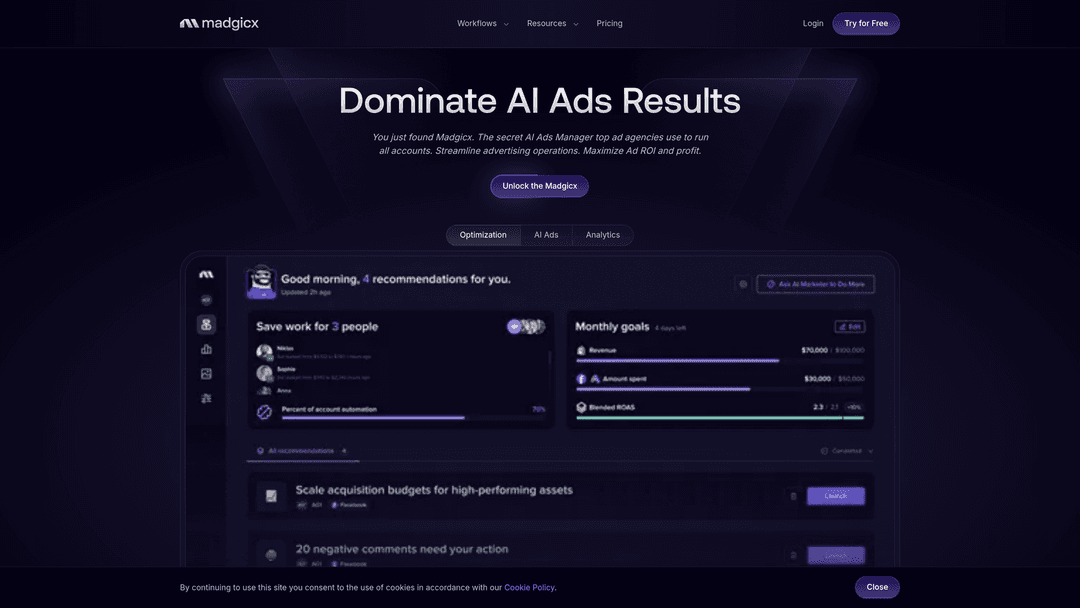
Madgicx is an AI marketing platform specifically designed for e-commerce advertisers on Meta.
Where This Tool Shines
Madgicx's AI Audiences feature automatically creates and tests audience segments based on your pixel data, finding hidden customer patterns you might miss manually. The platform analyzes conversion behavior, browsing patterns, and engagement signals to build audience clusters that share similar purchase intent or lifecycle stage.
When combined with bulk launching, this means you can quickly test dozens of AI-generated audience variations without spending hours in Audience Insights doing manual research. The system identifies micro-segments within your customer base—like "high-intent browsers who abandoned cart" or "repeat purchasers interested in specific product categories"—and automatically creates campaigns targeting each segment.
The platform's Creative Insights tool analyzes which visual elements, colors, and messaging themes drive performance across your campaigns. It breaks down your ad creative into components—headline style, image composition, color palette, call-to-action phrasing—and identifies which combinations resonate with different audience segments. This gives you data-backed direction for your next creative batch rather than guessing what might work.
This combination of intelligent audience discovery and creative analysis makes bulk launching more strategic. You're not just creating more campaigns faster—you're launching variations that have higher probability of success because they're informed by actual behavioral data.
Key Features & Capabilities
AI-Generated Audience Segments: The platform analyzes your Meta pixel data to automatically create audience clusters based on conversion patterns, browsing behavior, and engagement signals. These AI audiences often uncover customer segments you wouldn't identify through manual analysis.
Bulk Campaign Launcher: Create campaign matrices that test multiple audiences against multiple creatives simultaneously. The interface shows you exactly what combinations you're launching before you commit budget, preventing the "did I really set that up correctly?" anxiety of manual bulk creation.
Creative Insights Analysis: The system breaks down your ad creative into component elements and identifies which visual patterns, messaging themes, and design choices drive the best performance. This analysis helps you understand not just which ads won, but why they won.
Autonomous Budget Optimization: Madgicx continuously monitors campaign performance and automatically reallocates budget toward winning variations. The system can pause underperforming ad sets and scale winners without manual intervention.
One-Click Campaign Scaling: When you identify a winning campaign structure, you can duplicate it across new audiences or creative variations with a single click, maintaining the same optimization settings and campaign architecture.
4. Smartly.io
Best for: Enterprise brands running large-scale campaigns across multiple platforms
Smartly.io is an enterprise-grade advertising automation platform that handles bulk launching across Meta, TikTok, Pinterest, Snapchat, and Google.
Where This Tool Shines
Smartly.io's creative automation capabilities set it apart from simpler bulk launchers. The platform can automatically generate thousands of ad variations by combining product feeds with creative templates, adjusting messaging and visuals for different audience segments.
This dynamic creative optimization (DCO) means you're not just launching bulk campaigns—you're launching personalized ad experiences at scale. Think of it like having a creative team that can instantly produce custom ads for every audience segment without manual design work.
The platform's cross-channel orchestration lets you maintain consistent messaging while adapting creative formats for each platform's specifications. A single campaign concept can automatically transform into Meta carousel ads, TikTok vertical videos, Pinterest pins, and Google responsive ads—all from one creative brief.
For large brands with extensive product catalogs, this level of automation is transformative. Instead of manually creating ads for hundreds of products across dozens of audience segments, you build the template once and let Smartly.io generate the variations.
Key Features & Capabilities
Dynamic Creative Optimization: Automatically generates personalized ad variations by combining product data with creative templates, creating unique experiences for different audience segments without manual design work.
Cross-Channel Campaign Launching: Deploy campaigns simultaneously across Meta, TikTok, Pinterest, Snapchat, and Google while maintaining brand consistency and adapting to each platform's technical requirements.
Product Feed Integration: Connect your product catalog directly to the platform, enabling automated ad creation for catalog-based campaigns that update dynamically as inventory changes.
Automated A/B Testing Frameworks: Built-in testing structures that track statistical significance and automatically allocate budget to winning variations based on performance thresholds you define.
Predictive Budget Allocation: AI-powered budget distribution across campaigns and channels based on performance forecasts and historical patterns, optimizing spend efficiency at scale.
Enterprise-Grade Reporting: Comprehensive attribution modeling and cross-channel performance dashboards designed for organizations managing complex marketing operations across multiple teams.
Best For / Ideal Users
Smartly.io is designed for enterprise brands, large e-commerce companies, and agencies managing major accounts. If you're spending $50,000+ monthly across multiple advertising platforms and need sophisticated creative automation, this platform delivers the scale and intelligence required for complex operations.
5. AdEspresso (by Hootsuite)
Best for: Small to mid-sized businesses wanting simple bulk launching with built-in split testing
AdEspresso is a platform that takes a fundamentally different approach to bulk ad launching than enterprise platforms.
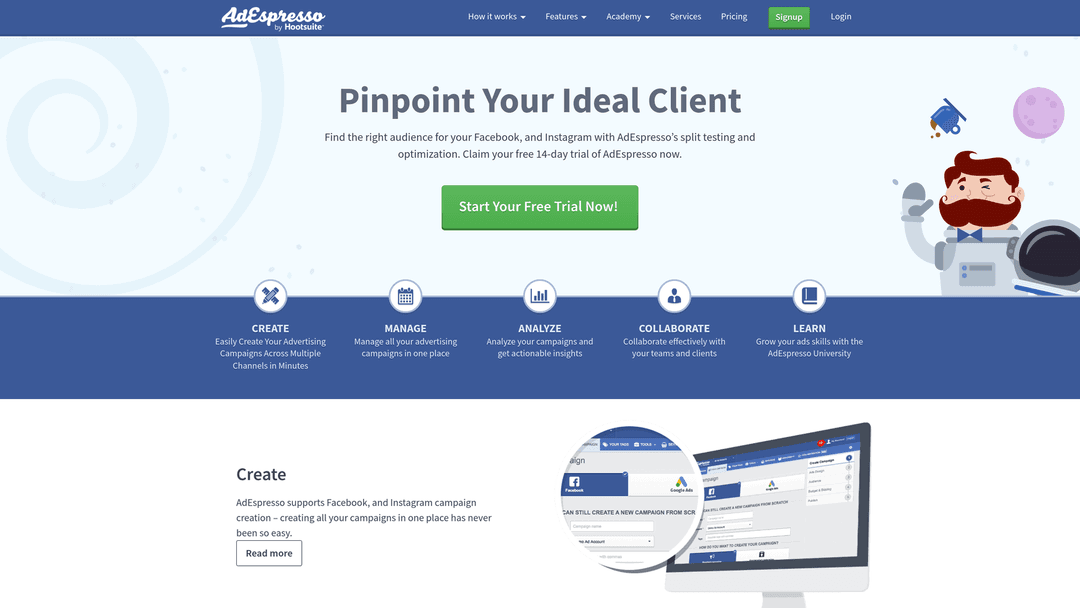
Instead of overwhelming you with advanced features and complex automation, it focuses on making the core task—creating and testing multiple campaign variations—as intuitive as possible. The platform's visual grid interface shows you exactly what you're building before you launch, which eliminates the anxiety of wondering whether you configured everything correctly.
What makes AdEspresso particularly valuable is its recognition that most marketers aren't full-time ad specialists. You might be wearing multiple hats—managing social media, creating content, analyzing data, and running ad campaigns. The last thing you need is a platform that requires hours of training videos before you can launch your first campaign.
Where This Tool Shines
AdEspresso's split testing grid is where the platform's philosophy becomes tangible. When you're setting up a campaign, you see a visual matrix that displays all your combinations: three audiences across the top, five ad creatives down the side, and the resulting fifteen ad variations clearly mapped out. This visual representation helps you catch potential issues before launching. You might notice you're testing too many variables at once, or that you forgot to include a key audience segment.
The platform guides you through campaign creation with a structured workflow that prevents common mistakes. It prompts you to define your objective first, then walks through audience selection, creative upload, and budget allocation in a logical sequence. For marketers who've experienced the chaos of Meta's Ads Manager—where you can easily lose track of what you've configured—this structured approach reduces cognitive load significantly.
AdEspresso's analytics interface focuses on answering the questions that actually matter: Which audience is performing best? Which creative is driving the most conversions? Should you increase budget on the winning variation? The platform highlights statistical significance, so you're not making decisions based on insufficient data. This prevents the common mistake of pausing ads too early or scaling variations that haven't proven themselves yet.
The platform also handles the tedious parts of campaign management that eat up time. Need to duplicate a successful campaign structure for a new product? AdEspresso lets you clone the entire setup and swap out creatives and copy in minutes. Want to test the same campaign on both Facebook and Instagram? The platform creates both versions simultaneously, maintaining consistent targeting and budget allocation.
Key Features & Capabilities
Visual Split Testing Grid: The campaign builder displays all your test variations in a clear matrix format, making it easy to see exactly what you're launching and catch configuration errors before they go live.
Cross-Platform Bulk Creation: Launch campaigns across Facebook, Instagram, and Google Ads from a single interface, maintaining consistent testing structures across platforms.
Campaign Cloning: Duplicate successful campaign structures and quickly modify targeting, creative, or budget parameters for new tests without rebuilding from scratch.
Statistical Significance Tracking: Built-in analytics that show when test results are statistically meaningful, preventing premature optimization decisions based on insufficient data.
Simplified Reporting: Performance dashboards that focus on actionable insights rather than overwhelming you with every possible metric.
6. Qwaya
Best for: Agencies needing collaborative campaign building with client approval workflows
Qwaya is a platform that treats collaboration as a core feature rather than an afterthought, building approval workflows directly into the bulk launching process.
If you've ever lost three hours to email chains about a single headline change, or had a client approve campaigns verbally only to request revisions after launch, you understand the agency pain point Qwaya addresses.
Where This Tool Shines
Qwaya's collaboration infrastructure solves the approval bottleneck that plagues agency workflows. You build bulk campaigns within the platform, then generate shareable preview links that show clients exactly what will launch—complete with creative assets, targeting parameters, and budget allocation. Clients review everything in their browser, leave comments on specific elements, and approve or request changes without downloading files or deciphering spreadsheets.
This eliminates the screenshot-attachment-feedback-revision cycle that typically adds days to campaign launches. When a client requests changes, you make edits directly in Qwaya, and the preview link updates automatically. Everyone sees the same current version, and you maintain a complete revision history showing what changed and when.
The scheduling capabilities extend this collaborative advantage to planning. You can build campaigns weeks in advance, schedule exact launch times, and coordinate multiple client campaigns across an editorial calendar. For agencies managing seasonal campaigns or product launches across different time zones, this advance planning prevents last-minute scrambles.
The bulk duplication features recognize that agencies often run similar campaign structures for different clients. You can save successful campaign templates, then duplicate them across client accounts with a few clicks. This isn't just copying campaigns—Qwaya lets you map different creative assets, adjust budgets, and modify targeting while maintaining the underlying structure that worked.
Key Features & Capabilities
Collaborative Campaign Builder: Create campaigns with built-in client preview and approval workflows that eliminate email chains and version confusion.
Bulk Campaign Creation: Use template-based duplication to replicate successful campaign structures across multiple client accounts efficiently.
Advanced Scheduling: Plan campaign launches weeks in advance with precise timing control, perfect for coordinating multi-client editorial calendars.
Multi-Account Management: Manage dozens of client accounts from a unified dashboard without constant platform switching or login juggling.
White-Label Reporting: Generate custom reporting dashboards that can be branded for client presentation, showing performance metrics in client-friendly formats.
Budget Pacing Tools: Set spending limits and pacing rules to prevent budget overruns across multiple campaigns and client accounts.
Best For / Ideal Users
Qwaya is purpose-built for agencies managing multiple client accounts who need streamlined collaboration and approval processes. If you're spending more time managing client feedback than optimizing campaigns, this platform addresses that workflow inefficiency directly.
7. Albert
Best for: AI-driven autonomous campaign management with minimal manual intervention
Albert is a platform that represents a fundamentally different approach to bulk launching.
Rather than simply creating multiple campaigns faster, Albert positions itself as an autonomous digital marketer that makes strategic decisions about what to launch, when to launch it, and how to optimize it—all with minimal human input.
Where This Tool Shines
Albert's AI operates on a different level than rule-based automation. While most bulk launchers execute the variations you specify, Albert analyzes cross-channel performance patterns and makes strategic decisions about budget allocation, audience targeting, and creative deployment. This means you're not just launching campaigns—you're deploying an intelligent system that will independently test, learn, and optimize those campaigns without constant oversight.
The platform's micro-segmentation capabilities demonstrate this autonomous approach. Albert can identify small audience segments within your broader targeting that show higher conversion potential, then automatically create and launch campaigns targeting those micro-segments. This happens without you manually analyzing data or building new audiences—the AI spots the opportunity and acts on it.
What makes this particularly valuable is the time shift it creates. Instead of spending hours managing tactical campaign adjustments, you focus on creative strategy and overall marketing direction while Albert handles the optimization work. For teams stretched thin across multiple responsibilities, this division of labor can be transformative.
Key Features & Capabilities
Autonomous Campaign Creation: Albert doesn't just launch what you tell it to—it analyzes performance signals and creates new campaign variations based on what the data suggests will work. This means discovering opportunities you might not have thought to test manually.
Cross-Channel Budget Allocation: The platform makes real-time decisions about where to allocate budget based on performance patterns across multiple advertising channels. If Meta is outperforming Google Ads for a specific objective, Albert shifts budget accordingly without waiting for you to notice and adjust manually.
Predictive Performance Forecasting: Albert uses historical data to predict how campaigns will perform, helping you understand expected outcomes before committing significant budget. This predictive capability informs which variations get launched and how much initial budget they receive.
Automatic Audience Micro-Targeting: The AI identifies high-performing sub-segments within your audiences and creates targeted campaigns for those groups. This granular approach often uncovers conversion opportunities that broad targeting misses.
Creative Performance Analysis: Albert analyzes which creative elements drive results and provides recommendations for future creative development. This closes the loop between campaign performance and creative strategy.
Best For / Ideal Users
Albert works best for mid-sized to large brands spending substantial amounts monthly who want to shift from tactical campaign management to strategic marketing direction. If you have the budget for AI-driven automation and want to reduce hands-on optimization time, Albert's autonomous approach delivers that operational efficiency.
8. Metadata.io
Best for: B2B companies running account-based marketing campaigns with bulk launching needs
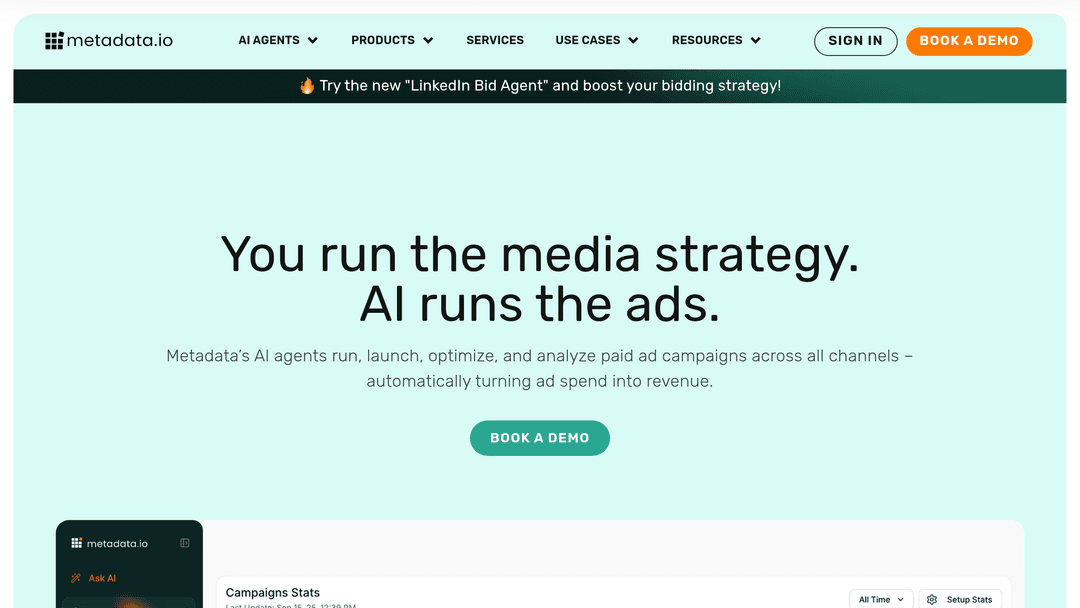
Metadata.io is a platform that focuses on B2B advertising automation, offering bulk launching capabilities specifically designed for account-based marketing (ABM) strategies.
Where This Tool Shines
Metadata.io's ABM integration sets it apart from general bulk launchers. You can upload target account lists from your CRM, and the platform will automatically create campaigns targeting decision-makers at those specific companies across LinkedIn, Meta, and Google.
The bulk launching happens at the account level rather than just audience level, meaning you can quickly spin up personalized campaigns for different industries, company sizes, or buying stages. Think of it like having a campaign assembly line that's programmed with your exact target account specifications—you feed in your account list, and the platform generates customized campaigns for each segment.
The platform's integration with tools like Salesforce and HubSpot means campaign performance data flows back to your CRM, closing the loop between advertising and sales outcomes. When a target account engages with your ads, that activity appears in your CRM alongside other touchpoints, giving your sales team context about which accounts are showing interest.
This closed-loop reporting transforms bulk launching from a volume play into a strategic ABM execution tool. You're not just launching more campaigns—you're launching campaigns that align with your sales team's target account priorities and feeding engagement data back into your go-to-market systems.
Key Features & Capabilities
Account-Based Campaign Creation: Build campaigns targeting specific companies rather than broad demographic audiences, aligning advertising with your sales team's target account lists.
CRM Integration: Synchronize target account lists directly from Salesforce, HubSpot, or other CRM systems, ensuring your campaigns always reflect current sales priorities.
Cross-Platform Launching: Deploy bulk campaigns across LinkedIn, Meta, and Google Ads simultaneously, maintaining consistent messaging while adapting to each platform's format requirements.
Personalized Creative Variations: Automatically generate ad variations based on company attributes like industry, company size, or technology stack, making campaigns feel tailored rather than generic.
Pipeline Attribution: Track how ad engagement connects to pipeline generation and closed deals, proving advertising's impact on revenue rather than just engagement metrics.
Account Engagement Optimization: Automatically adjust campaign tactics based on account-level engagement patterns, focusing budget on accounts showing buying signals.
Best For / Ideal Users
Metadata.io is purpose-built for B2B marketing teams running ABM programs who need to coordinate advertising with sales priorities. If your marketing strategy revolves around target account lists and you need advertising that integrates with your CRM workflows, this platform delivers that specialized functionality.
Making the Right Choice
The right bulk ad launcher depends on where you are in your scaling journey and what level of intelligence you need baked into the automation.
If you're an agency juggling multiple client accounts, Revealbot and Qwaya deliver the multi-account management and collaboration features that prevent workflow chaos. For e-commerce brands with extensive product catalogs, Madgicx's creative insights and Smartly.io's dynamic creative optimization turn bulk launching into personalized advertising at scale.
Performance marketers who want their bulk launcher to actually think—not just execute—should evaluate AI-powered platforms. AdStellar stands out here by analyzing your historical performance data to generate smarter campaign variations, not just more of them. Instead of manually specifying every test combination, you're launching campaigns that already incorporate proven patterns from your account history.
B2B teams running account-based strategies need Metadata.io's CRM integration and company-level targeting. Enterprise brands spending six figures monthly across multiple channels should explore Smartly.io or Albert for cross-platform orchestration.
The common thread across successful implementations? Teams that view bulk launching as strategic leverage, not just time savings. The best tools don't just help you launch faster—they help you launch smarter by incorporating data, learning from results, and continuously refining what gets deployed.
Ready to transform your campaign creation from manual grind to AI-powered strategy? Get Started With AdStellar AI and see how intelligent automation accelerates your Meta advertising results.